What is a Nerdminer?
The Nerdminer is a tiny, low-power Bitcoin mining device, built more as an educational project or “lottery miner” than as a machine that makes real money. It runs on a microcontroller (the ESP32, for example) and mines solo with an extremely low hashrate, which makes the odds of finding a block effectively zero, comparable to winning the lottery several times in a row. Even so, it has caught on among enthusiasts for its low cost and for letting you experiment with Bitcoin mining at almost no energy expense.
If you’re wondering whether one of these little gadgets is worth buying, I’d point you to this article: Is a Nerdminer worth it?
And if you trust your luck and want to mine BTC with one of these things, here are the ones I find most interesting. To me they’re a great way to get into Bitcoin.
These products carry my affiliate link, so if you buy through them you help keep this blog running at no extra cost to you.
Mining performance
The Nerdminer’s mining performance is very limited. The microcontroller-only versions (like the Nerdminer V2 and Micro) reach somewhere around 50 to 78 kilo-hashes per second (KH/s). The Nerdminer V2, for instance, runs at roughly 70–78 KH/s drawing about 1–1.5 W, whereas a professional ASIC like the Antminer S19 operates at 110 tera-hashes/s (TH/s) on 3,250 W. In other words, the Nerdminer is millions of times slower.
Even the newer Nerdminer models with an integrated ASIC improve on that but still fall far short: the NerdAxe (a recent expansion) climbs to ~500 GH/s at ~12 W. That’s a jump of nearly 10,000× over the original ~50–56 KH/s, but it’s still barely 0.5 TH/s, nothing against the ~400 EH/s (exahashes) of total Bitcoin network power. The bottom line: the Nerdminer mines at a symbolic pace. As one user on ForoCoches put it, its “mining power is extremely ridiculous“, fine for displaying data on screen (hashrate, fees, price, and so on) but not for earning rewards.
Better than buying a Nerdminer is building one yourself. I wrote this step-by-step tutorial for building a Nerdminer v2. A project that teaches you a lot about mining, programming, and networks.
Cost vs. benefit
From a profitability standpoint, the Nerdminer offers no real economic upside. The assembled kit runs about $50–60, on top of a tiny electricity draw (~1 W). The point that matters here is that the chance of recouping your investment by mining is practically nil. One analysis puts the daily odds of a Nerdminer mining a block at around 2.5×10^−18; put another way, “you’re more likely to win the lottery 11 times in a row than to mine a block with a Nerdminer.”
Bottom line: as a Reddit thread concludes, if your goal is to make money, a Nerdminer “isn’t worth it.” The only shot at a return is the “stroke of luck” of solving a block, and the resulting prize depends on how much BTC you mine and the exchange rate.
In this article I share the full math behind the probability of a Nerdminer mining a Bitcoin. It’ll make your head spin.
Ease of use
One of its real strengths is how easy the Nerdminer is to use and set up. It ships with the mining firmware preinstalled, and getting it running is almost plug-and-play. The Nerdminer V2 only needs a USB connection (it can even be powered from a PC port) and gets configured over WiFi. The first time you turn it on, the device shows a QR code on its screen; scanning it with your phone opens the device’s WiFi setup, where you just enter your home network password and the Bitcoin wallet address where any rewards would land.
After that, it starts mining on its own. The process is simple enough that most buyers don’t even need an advanced guide. In under a minute you can have it running. Pretty cool, right? On top of that, the Nerdminer’s compact, palm-sized form factor and its low heat and noise make it ideal for a desk. The Nerdminer Micro, for example, is even smaller (5×3×1 cm) and doesn’t even need a fan, so its power draw and noise are minimal.
By comparison, the ASIC kits (like the NerdAxe and the Bitaxe) include a small fan that makes some noise, but they’re still fine for the home. In fact, one ForoCoches user says he prefers the Nerdminer for being “tiny and completely silent”, over a Bitaxe that’s more powerful but louder.
In short, assembling and using a Nerdminer is very simple, even for beginners, and that’s part of its educational appeal.
How the versions differ, and how they evolved
The Nerdminer V2 (2023) was the pioneering model that popularized these micro-miners. It’s built on an ESP32 board with an integrated screen, fan, and case, delivering ~70 KH/s at ~1 W. This is the device that started it all, setting off a wave of small-scale open-source mining projects in 2023. The Nerdminer Micro (2023) is a stripped-down variant: same firmware, but in a smaller module with no screen and no fan, hitting up to ~50 KH/s on just ~0.3 W. It gives up local display (though it usually connects to web monitors) in exchange for smaller size and lower cost, ideal for anyone who wants to tinker on the cheap.

Finally, the NerdAxe (2024) marks a generational leap, since it adds a Bitcoin ASIC chip (the Bitmain BM1366) as an accelerator. It’s essentially an expansion kit created by the same developer (Bitmaker) to combine the Nerdminer with a Bitaxe. With dedicated hardware on board, the NerdAxe reaches ~500 GH/s at 12 W while keeping the ESP32 in charge of management. That’s a massive performance increase (4–5 orders of magnitude) over the original Nerdminers, bringing these devices closer to serious mining scale. The trade-offs are higher cost ($120 for the full kit) and the need for an external 5V/2–3A USB power supply. Even so, it’s still low-power compared with professional ASICs and doesn’t guarantee a positive ROI, though it does nudge the odds up a little.
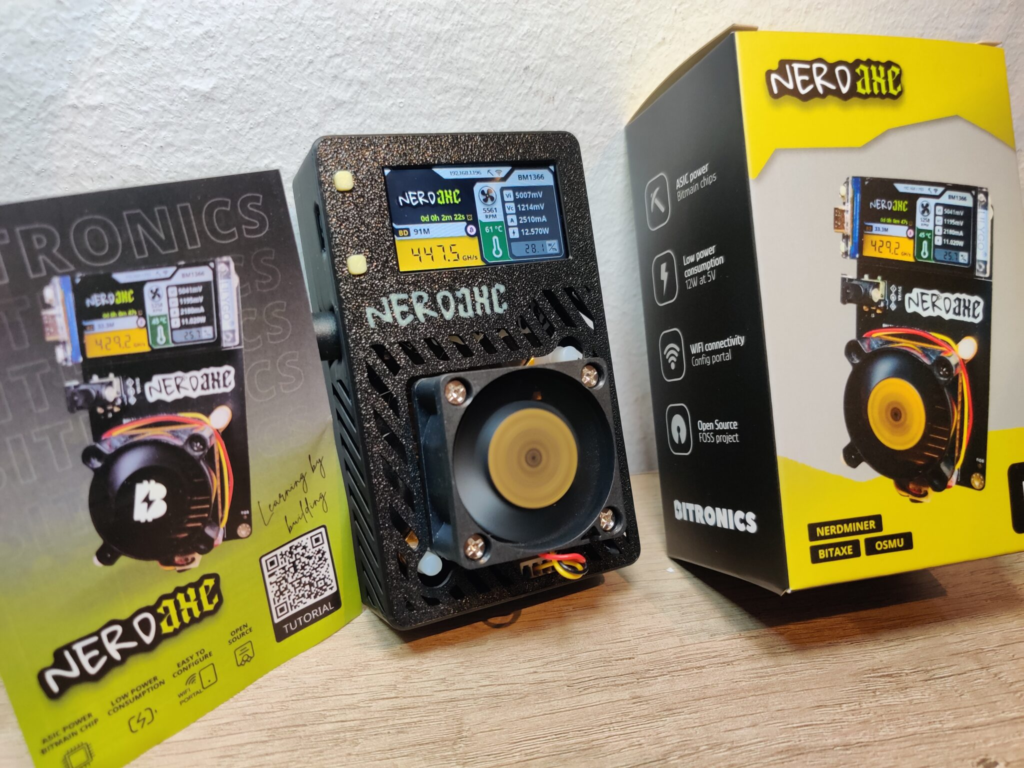
In practice, every Nerdminer shares the same “lottery” philosophy: from the few-KH/s micro-miners to the 0.5 TH/s NerdAxe, none of them guarantees earnings, they only raise the minuscule probability of success as the hashrate goes up.
A question I get a lot: is there a Nerdminer V3? Short answer, not really, the “V3” you see floating around is mostly clustered V2 units rather than a new architecture. I break down whether a Nerdminer V3 exists and where to buy one in a separate piece.
Recent versions compared
| Model | Hashrate | Power draw | Efficiency (GH/s per W) | Price (€) | Extra features | Use case / notes |
|---|---|---|---|---|---|---|
| Nerdminer V2 | ~70–78 KH/s (0.07–0.078 GH/s) | ~1–1.5 W | ~0.05–0.07 | Check price | Screen, fan, open-source (LilyGO ESP32-S3) | Shows real-time stats |
| Nerdminer Micro | ~50 KH/s (0.05 GH/s) | 0.3 W | ~0.167 | Check price | Board only, WiFi config, ultra-low power | Ideal for getting started with discreet, educational mining |
| NerdAxe | ~500 GH/s | 12 W | ~41.67 | Check price | ASIC kit; needs an ASIC board + Nerdminer | Combines learning with real low-power mining |
What the community says
Across forums and social media, recent opinions on the Nerdminer mix realism, humor, and genuine enthusiasm. I pulled the most useful takes together in my full Nerdminer review:
- Hype vs. reality: Plenty of users recognize the Nerdminer is, above all, a curiosity. On Reddit, when someone asked if it was worth it, the top-voted reply was “It’s not. More of a novelty than anything.” Similarly, on ForoCoches they call it a “toy for tinkering“ in the mining world.
- Educational value and decentralization: Despite its economic uselessness, many value the Nerdminer for its educational and philosophical purpose. One enthusiast notes that owning one makes him happy to be part of the BTC network, even at a tiny hashrate. Others point out that while it “adds to decentralization“ only in a microscopic way, it’s exciting to contribute. Being able to run a full mining node on open hardware thrills the cypherpunk community, mostly for the control and the experimentation it offers.
- Humor and embracing the odds: There’s a lot of joking acknowledgment of the vanishingly small probabilities. Lines like “So you’re telling me there’s a chance?“ get shared sarcastically when someone posts the odds of mining a block with one of these lottery miners. One popular comment sums up the general attitude: “It’s completely useless… and yet I need one!“, which captures the fact that a lot of people buy the Nerdminer for fun, not for profit.
The alternative everyone mentions: Bitaxe
On forums and social media, comparisons with similar projects come up. People mention that a Bitaxe (another open-source USB miner) offers higher hashrate (even into the tera-hash range in its advanced versions) but at the cost of more noise and higher power draw. In fact, some who start with a Nerdminer later consider moving to a Bitaxe/NerdAxe for “a bit more to play with” technically. That said, there are also those who prefer the Nerdminer for its simplicity and silence. Overall, the community sees the Nerdminer as the gateway to home mining: “a great way to learn about mining,” while more powerful options like the NerdAxe/Bitaxe are the next steps if you want to go deeper.
The Nerdminer: a fun way down the Bitcoin rabbit hole
Personally, I like the Nerdminer and its alternatives for the educational angle on Bitcoin. Buying a Nerdminer, or giving one as a gift, opens a door to everything around Bitcoin: blockchain, investing, mining, cryptocurrencies. Bitcoin is a good proxy for learning, in an entertaining way, about the principles that govern economics, systems, and ultimately societies.
If you want to keep digging into the Nerdminer, here’s a curated set of resources to help:
| Resource name | Type | Language | Link | Description |
|---|---|---|---|---|
|
BitMaker-hub/NerdMiner_v2 (GitHub) (Official project) Recommended | Code/repository | English | GitHub: BitMaker-hub/NerdMiner_v2 | Official repo with open-source firmware, README, instructions, binaries, and community support. |
| r/NerdMiner (Reddit) | Community forum | English | Reddit: r/NerdMiner | Active Reddit community for discussing setups, sharing photos, and troubleshooting the NerdMiner. |
| “NERDMINER: Bitcoin lottery miners” thread (Bitcointalk) | Technical forum | English (original post) / multilingual | Bitcointalk: View thread | Bitcointalk debate with expert opinions, highlighting how easy it is to assemble and its nature as an educational gadget. |
| Forocoches – NerdMiner topic (“¿Qué opináis…?”) | Community forum | Spanish | Forocoches: View discussion | Spanish-language discussion on Forocoches with experiences, questions, and comparisons; focused on the educational side and practical tips. |
| NerdMiner Setup Guide – Nerdminers.com | Tutorial (blog) | English | Nerdminers: Setup Guide | Step-by-step tutorial for building and configuring the NerdMiner on a LilyGO T-Display S3, with flashing methods, Wi-Fi and BTC setup, and illustrated tips. |
| Instalar y Configurar NerdMiner v2 – TuGuía Digital Recommended | Tutorial (article) | Spanish | TuGuíaDigital: NerdMiner tutorial | Complete Spanish-language tutorial for building a NerdMiner on the ESP32, with instructions for flashing, Wi-Fi, wallet, and monitoring; ideal for beginners. |
| NerdMiner Instruction Manual – SatoshiStore.io Recommended | Official guide | English (German available) | SatoshiStore: NerdMiner manual | Official SatoshiStore guide with detailed instructions for assembly, flashing, configuration, and troubleshooting; thorough and clear. |
| “Build your Bitcoin Miner (NerdMiner v2)” – BitMaker (YouTube) | Video tutorial | Spanish (audio) / English (title) |
YouTube: Watch video (BitMaker channel) | Video tutorial from developer BitMaker showing the build and basic setup of the NerdMiner v2, with demos and practical tips. |
| “$50 Tiny Bitcoin Miner – NerdMiner V2 Review” – VoskCoin (YouTube) | Video (review) | English |
YouTube: Watch video (VoskCoin channel) | VoskCoin video review of the NerdMiner v2, assessing its setup, usefulness as an educational gadget, and low cost (~$50), with comparisons to other rigs. |
Frequently asked questions
Has anyone made money with a Nerdminer?
Not with a Nerdminer. Because of the Bitcoin network’s high difficulty, the odds of a solo miner solving a block and claiming the reward are extremely low. Making money with a NerdMiner is theoretically possible, but in practice it’s highly improbable.
Is solo mining worth it?
Solo mining means an individual miner tries to solve transaction blocks without joining a mining pool. The potential rewards are larger, but the odds of success are very low because of the network’s high difficulty. That’s why most miners join pools to get more consistent, if smaller, rewards.
How many bitcoins have been mined?
As of July 2024, roughly 19,719,542 bitcoins had been mined, which is 93.81% of the total 21 million supply. That leaves around 1,280,458 bitcoins still to be mined.
How is Bitcoin mined?
Bitcoin mining is the process that validates and records transactions on the blockchain. Miners use specialized hardware to solve complex math problems, and the first to solve it adds a new block to the chain and receives a reward in bitcoins. Because of the high competition and difficulty, miners commonly join pools to improve their chances of earning rewards.
Is it still worth mining Bitcoin?
Bitcoin mining profitability depends on several factors: the cost of electricity, hardware efficiency, and the market price of Bitcoin. In 2025, the extraction cost for most leading miners is estimated between $26,000 and $28,000 per Bitcoin. With Bitcoin’s price around $85,000, mining remains profitable for those with efficient rigs and access to cheap energy.
What happens when Bitcoin mining ends?
The last Bitcoin is estimated to be mined around the year 2140. Once all 21 million bitcoins have been mined, miners will stop receiving block rewards. They’ll keep earning income through transaction fees, though, which are expected to rise as the network grows and gets used more.
How much electricity does it take to mine 1 Bitcoin?
The energy needed to mine a Bitcoin varies with the efficiency of the hardware used. On average, it takes around 266,000 kilowatt-hours (kWh) to mine a Bitcoin, roughly the annual consumption of about 24 average US households.
What is the highest price Bitcoin has ever reached?
The highest recorded Bitcoin price was $109,114, reached on January 20, 2025. That all-time high beat the previous peak of $108,300 set in December 2024.
And these are my articles on the Nerdminer